

Greater collaboration needed to tackle growing cyber threat
by Bija Knowles
Greater organisational collaboration in the financial services sector and working alongside law enforcement and government agencies are central to beating cyber criminals, says a report by UK Finance and KPMG. Staying Ahead of Cybercrime says that the finance industry spends three times more on cyber security compared to other sectors – but that spending alone will not tackle the threat. Collaboration is therefore an important approach, both internally within companies and between private and government organisations. Cyber crime is worth more than $450 billion a year, as crime, extortion, blackmail and fraud move online and is now the second greatest threat to the UK financial sector, following political risk.
Community-based approach
The report states: “To be effective in addressing this risk, the approach of businesses across all sectors needs to change to a community-based and comprehensive approach to disrupting the criminal ecosystem. This demands that we understand the threat from the perspective of ruthless and rational cyber criminal entrepreneurs, and that we work together across the financial community, key industries, law enforcement and governments to break their business models.”
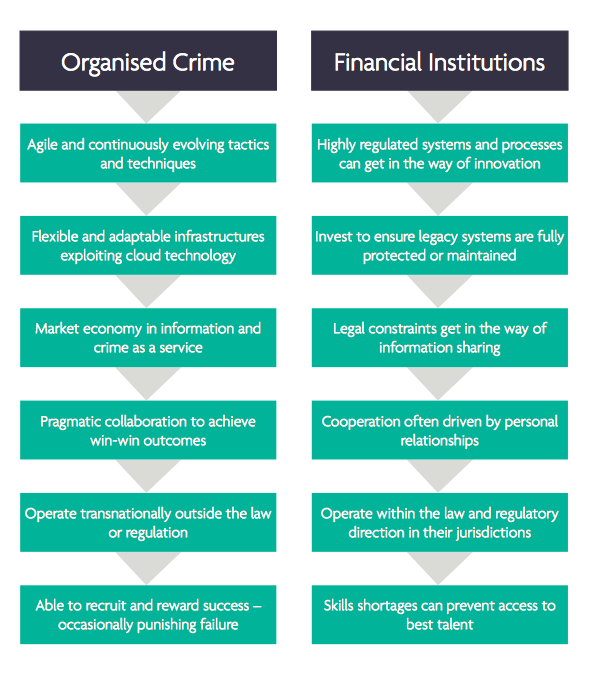
The report draws a comparison between the methods used by cyber criminals and marketing operations, as criminals seeks to constantly evolve their approach and adapt very quickly to market nuances to find the 'gap in the market'. The report says: “One challenge the industry must address is not to see cyber security as merely a governance, risk and control issue, but as a matter of competition with a digital adversary. In many respects, the way businesses approach identifying and harnessing digital channels to market is much closer to the business models adopted by criminals. Businesses continuously evolve their market offerings, looking for new opportunities. They test new routes to market, and do so at pace in order to create competitive advantage.”
System constraints on financial sector
It also highlights how financial institutions are constrained by a number of factors, including laws and regulations in the jurisdictions in which they operate, internal policies and structures, as well as legacy systems.
Like this item? Get our Weekly Update newsletter. Subscribe today