

Multinationals to benefit most from US tax reform
by Bija Knowles
Half of US chief financial officers (CFOs) think that large companies will benefit the most from the tax reform bill passed yesterday in the US. This is according to research by CNBC's Global CFO Council survey, which also found that very few CFOs expect the rate of corporate income tax – from 35 per cent down to an official rate of 21 per cent – to benefit the average US worker. Just 8 per cent said the tax reform is most likely to lead to an increase in employee wages next year, while even fewer expect companies to start hiring extra staff as a result. This is a stark contrast to the words of President Trump, who said the tax reform bill would be: “one of the great Christmas gifts to middle-income people.”
But the tax reform is certainly good news for multinational corporations and will significantly reduce the tax they pay in the US. As for US companies operating outside the US, they will also pay a lower rate of 15.5 per cent to repatriate cash to the US in a one-off transaction.
CNBC's Global CFO Council survey found that 12.5 per cent of CFOs said the middle class would benefit the most from tax reform, while only 8 per cent said wealthy individuals or small business would see the greatest benefit. This doesn't necessarily tally with the substance of the tax bill, which will see wealthy individuals earning above $500,000 pay more than 2 per cent less on earnings above that threshold, while workers in the lowest-income bracket will benefit least, with a tax reduction of just 0.1 per cent, according to figures from BBC News.
The figure below also shows that an increase in stock buybacks is one of the most probable outcomes of the US tax reform, with more than 40 per cent of CFOs saying this would be 'likely' or 'most likely'. (CNBC notes that in the graph: “Likely" is the sum of those who responded "most likely" or "likely." "Not likely" is the sum of those who responded "not likely" or "least likely.")
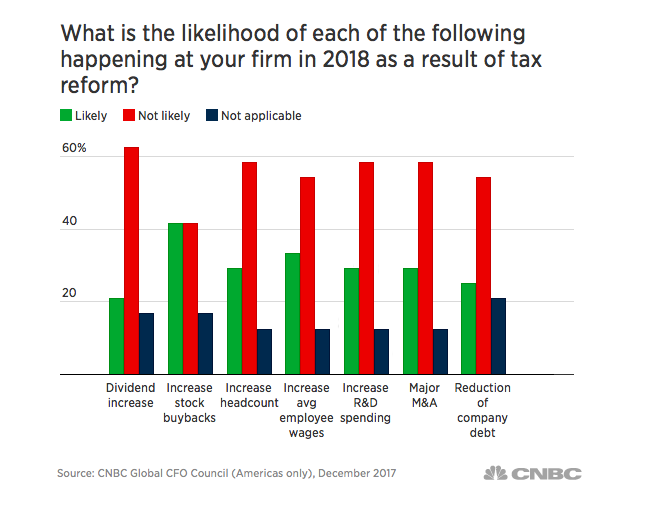
The Global CFO Council survey was based on responses from a small group of just 24 CFOs in North America, who were questioned in the second week of December.
Like this item? Get our Weekly Update newsletter. Subscribe today