

Rising inequality underpins global risks – view from Davos
by Kylene Casanova
How do the world's business leaders view risk? According to the World Economic Forum's global risks report 2017, risk experts are taking note of growing inequalities in society.
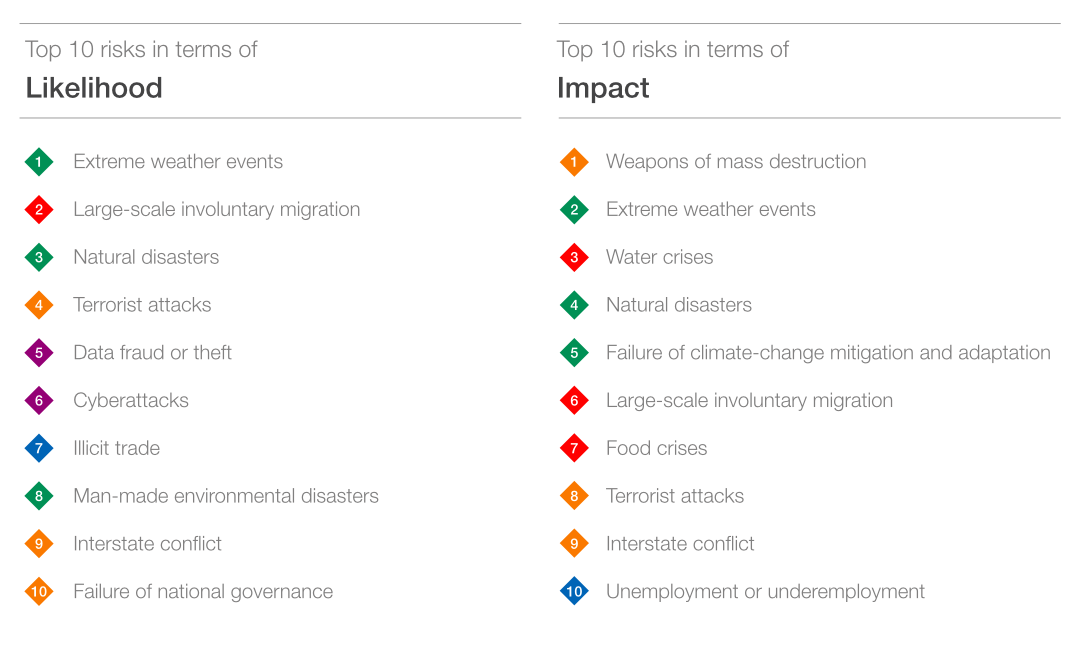
The Global Risks Report 2017, which aggregates the opinions of nearly 750 experts on the perceived impact and likelihood of 30 prevalent global risks and their interconnections, names the top five trends that determine global developments as follow:
- rising income and wealth disparity;
- changing climate;
- increasing polarisation of societies;
- rising cyber dependency; and
- ageing population.
Top 10 risks - most likely and most impactful
It also lists the top 10 risks in terms of both likelihood and impact, as shown in the following tables:
Addressing the risks
In its introduction the report notes that “across the globe there is evidence of a growing backlash against elements of the domestic and international status quo”, referring to the unexpected election wins in the US and the UK in 2016. The report's introduction picks out some points of action that could address some of these trends and risks:
- reviving economic growth;
- reforming market capitalism;
- facing up to the importance of identity and community;
- managing technological change; and
- protect and strengthen our systems of global cooperation.
Top risks of 2016
Last year the World Economic Forum's Global Risks Report 2016 named the top five most impactful risks as:
- the failure of climate change mitigation and adaptation;
- weapons of mass destruction;
- water crises;
- large-scale involuntary migration; and
- severe energy price shock (increase or decrease).
CTMfile take: It's interesting that the survey's participants are now picking up on societal inequalities and have identified this as an underlying cause of the political instability in the past 12 months. In terms of most impactful risks, climate change is still in the top five this year. Migration no longer features in the top five in 2017. Energy price shocks have also fallen out of the top five this year, while natural disasters, severe weather events and water crises are all in the top five (and could arguably all be related to the failure to address climate change). Weapons of mass destruction is up to first place this year, from second place in 2016.
Like this item? Get our Weekly Update newsletter. Subscribe today