

What can digital payments learn from cash?
by Kylene Casanova
We often hear that digital payments are paving the way for the elimination of cash. But according to the Bank of England, there are more coins and banknotes in circulation than ever before.
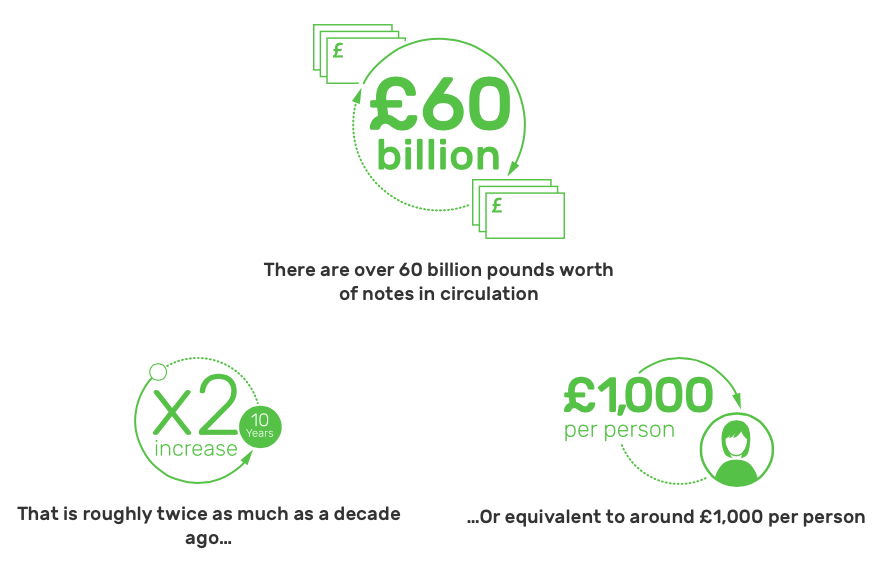
The UK's central bank has said that there is more than £60 billion-worth of coins and notes in circulation in the UK, which is roughly twice the amount in circulation 10 years ago. Given the proliferation of digital payments in the past decade, such as PayPal, mobile payments and contactless payment technologies, which enable us to buy goods, travel and even pay our friends and family without ever needing to reach for our wallets, the BofE data seems very surprising.
The bank states: “A large amount of banknotes are held in the UK to pay for things: the cash in our wallets; in shop tills; in banks and ATM machines. People also hoard cash as a form of savings. Large sums are also likely to be held overseas or for illegal uses: the so-called ‘shadow’ economy.”
Why cash has staying power
So, despite digital payments becoming ever more widely accepted, the BofE underlines that cash is probably here to stay for the foreseeable future and will remain popular for the following reasons:
- It is a fast and convenient way to pay
- It is very widely accepted
- It is helpful for budget management
- Some people also like the fact that cash payment is entirely anonymous. It is easy to access cash, with over 50,000 cash machines in the United Kingdom that are free to use.
CTMfile: The Bank of England's statement on the staying-power of cash coincides with the introduction of the new polymer five-pound note. The reasons why we still like to use cash are important for the payments industry as whole (particular the innovative segment that is pushing the boundaries to create new types and greater security for digital payments). If new digital payments (and their security/ID checks) are not fast, convenient and widely accepted, they will struggle to take off.
Like this item? Get our Weekly Update newsletter. Subscribe today