

How to maximise e-invoicing cost saving and revenue generation opportunities
by Kylene Casanova
The latest research by PayStream Advisors into the development of e-invoicing found that:
- As the electronic invoicing market becomes more saturated in large companies, the small and medium enterprise (SME) market, those with annual revenues under $250 million, continue to open up.
- New and improved innovations in eInvoice functionality including Software- as-a-Service (SaaS), free supplier portals, dynamic discounting and mobile transactional capabilities are the driving forces behind the increase in adoption in the middle market.
Benefits to buyers
The research showed that the main benefits of e-invoicing to the buyer’s A/P department are shown in the diagram below:
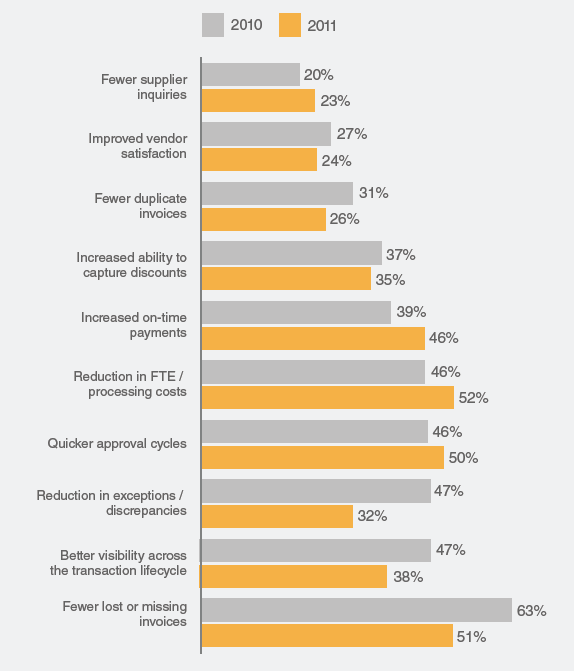
Source & Copyright©2014 -PayStream Advisors
Benefits to suppliers
Crucially PayStream Advisors found that there are real benefits for suppliers who have migrated to e-invoicing, including:
- Increased Efficiencies: Significant time is saved when employees do not have to print paper invoices and mail them to their customers, freeing up accounts receivable staff to focus on more value-added activities like collections and customer relations.
- Lower Costs: Reduction in labor, material and postage costs are common with all eInvoicing solutions. Our research reveals that suppliers who adopt electronic invoicing can slash their invoice management costs by more than 50 percent.
- Error Reduction: Validation rules configured into eInvoicing solutions flag errors at the time of submission and prompt suppliers to correct them, reducing the number of exception invoices downstream.
- Faster Settlement: Electronic invoicing shortens the invoice processing and approval cycle on the buyer side. Combined with electronic payments, this ensures that suppliers are paid on time, or in some cases, early.
- Improved Visibility: Suppliers have real-time access to invoice and payment status from a standard Web browser, providing for quicker handling of reconciliation questions and fewer help desk calls.
- Better Cash Flow Forecasting: Automating invoice processing and payments reduces uncertainties. Consistency around payment timing means suppliers can better perform cash flow forecasting.
- Eliminate Reprint Requests: Electronic invoicing solutions drastically reduce the number of lost and missing invoices, which means reprint requests from buyers will virtually be zero.
- Quicker Dispute Resolution: Suppliers now can view disputed invoices at any time and provide supporting/backup documentation as needed, making dispute resolution a collaborative process as well as accelerating resolution.
- Decreased Days Sales Outstanding: Dynamic discounting and supply chain finance capabilities available as part of eInvoicing solutions allow suppliers to decrease days sales outstanding (DSO) without adversely affecting customer relations.
- Access to Cheaper Capital: Dynamic discounting delivers financing at more attractive rates to suppliers than factoring or asset based lending.
These benefits will help to convince suppliers and overcome their resistance to change, and to prove “what is in it” for them making it worthwhile to overcome the technical challenges and adopting new business practices.
Report sponsor
Taulia, who sponsored the report, were founded in 2009 and is a provider of cloud-based invoice, payment and supplier financing management solutions for large buying organisations globally.
Conclusions
PayStream overall conclusions were that:
- Early eInvoice adopters have witnessed firsthand the efficiency and cost saving opportunities derived from AP automation. The SME market is now tapping into eInvoicing and AP automation initiatives to reap the benefits that the large early adopters did. However, companies of all sizes are now realising that eInvoicing is just scratching the surface of AP automation and additional opportunities lie ahead in the form of automated workflow, P2P automation, improved cash flow and working capital management.
- Companies currently considering AP automation need to plan beyond eInvoicing and know what they plan to do with the data once they get it. Without a supplier management strategy and a culture conducive to workflow automation, the potential for friction is high. This problem needs to be addressed with appropriate e-invoicing suppliers.
Like this item? Get our Weekly Update newsletter. Subscribe today