

ISO 20022 Readiness and the Procrastinator’s Motto
by CTM News Team
Swift shifts ISO 20022 readiness date out a year
Update and expansion of previous article. Swift announced the deferral of mandatory ISO 20022 readiness requirements out into November 2027. The exact date has not been established. The related payment systems, referred to as market infrastructures by Swift and other payment experts, have moved their dates to align with Swift. This includes the U.S. Fed Wire System and the Bank of England’s CHAPS (Real-Time Gross Settlement system).
Note: Elements of SR 2026, non-payment portions, have been delinked and are now targeted for Q1 2027. Learn more at swift.com.
https://www.swift.com/standards/standards-releases
Across the globe, compliance requirements for payments are creating significant work for companies that are working to be in compliance. In the U.S., changes for the low-value payment network (Nacha) have two key dates, including one that has already passed, that impact every company that originates ACH transactions.
The changes being brought about by ISO 20022 standardization have impacted banks and fintech providers who serve banks, Swift, and central bank payment rails. This impacts many companies in every country. There are three dates for payment readiness in 2026: 20-March; 22-June; and now November 2027 given the shift announced by Swift. The first two relate to ACH activity, and the last one for payments using the ISO 20022 standards.
There are three critical dates for payment readiness in 2026: 20-March; 22-June; November 2027. Two relate to ACH activity and one for payments using the ISO 20022 standards.
The extra time for compliance with the ISO 20022 readiness standards should be used to get ready as soon as possible, says Craig Jeffery, Managing Partner of Strategic Treasurer and the publisher of CTMFile. He further states, “The procrastinator’s motto, ‘Don’t put off until tomorrow what you can put off until the day after tomorrow,’ should not be used to delay any work that has been started in moving to the hybrid or structured environment or work needed to validate and confirm address information in your system.”
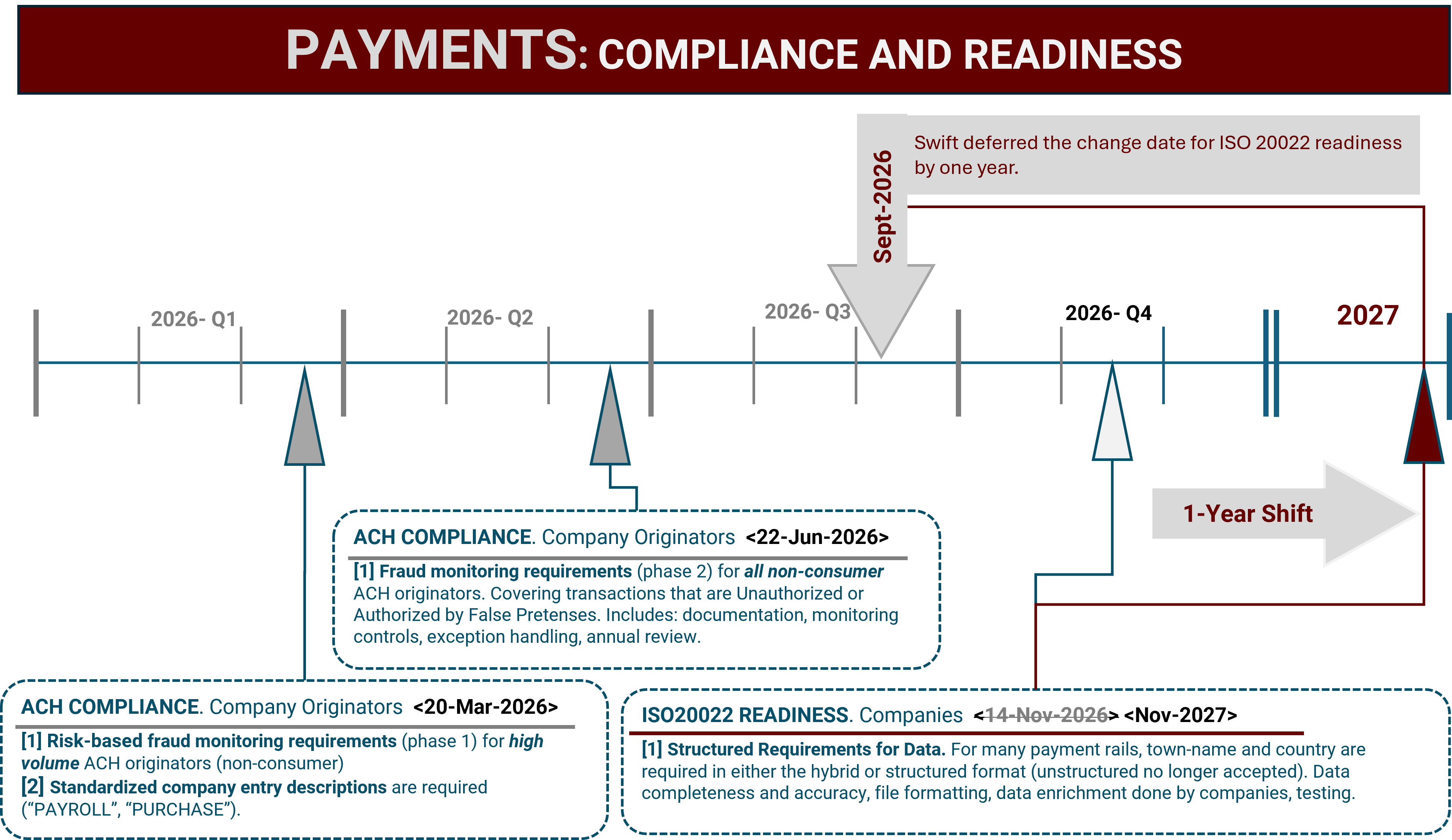
ACH Compliance (Low Value Payments in the United States). Changes with compliance for ACH transactions (direct deposit of payroll, direct payments, and direct debits) are impacting all non-consumer originators of ACH transactions. From the nearby chart, two activities stand out:
- Company Entry Descriptions. Transactions related to two types of activity need to include either “PAYROLL” or “PURCHASE” in the company entry description. This requires either a table or system change when creating these files.
- This went into effect 20-March-2026 for all originating companies. A company with payroll or accounts payable transactions settling by ACH has to comply with these new requirements.
- Fraud Monitoring. Fraud impacts every payment rail, and these rails are fighting back by requiring every company using their rail to perform certain functions (e.g., cards: PCI-DSS 2004, Swift: Swift-CSP 2017). Now, Nacha requires all companies to put fraud monitoring in place to cover unauthorized transactions or transactions that were authorized under false pretenses (e.g., social engineering). There are requirements of documentation, monitoring controls, exception handling and escalation, and an annual review. This, in essence, covers every business that has ACH transactions. This is in the process of being implemented in two phases.
- High volume: 20-March 2026
- All other companies: 22-June 2026
ISO 20022 Readiness (SEPA Payments, Wire Payments U.S., CHAPS UK, etc.). Most systems that manage payments at central banks and messaging services (referred to as payment infrastructure by Swift and many bank payment professionals) have been converted to natively run ISO 20022. The need for more detailed information for better processing and compliance is placing demands outside the banking infrastructure and onto corporations and fintechs that service them. The need for better clarity of individual fields of data and reason codes is expanding and increasingly essential for settlement to occur.
For an increasing number of countries receiving payments cross-border, and sometimes within country, payment categorization is required. Others require more detailed address information handled separately. This can range from building number to floor, town/city, and country designations. The use of large reference fields that contain data that is unstructured either slows processes down or will cause a payment to reject.
- Structured Information: City/Town, Country. Now effective November 2027, payments passing through various systems (FED Wire, Chips, CHAPS) will need to have data in either a hybrid or structured format. For example, the city/town and country information will need to be sent as separate fields for the payment to be processed. Also, while sending payments using ISO 20022 via XML (e.g., pain.001 format) may appear to meet the requirement, that isn’t the case. The correct information needs to be sent in a detailed manner with the correct tags. Many companies are finding out that some relevant payee master data is either not accurate or not included in their payment system, meaning some data remediation is needed for those payees to get paid electronically.
“Too many companies are not in compliance with Nacha requirements for company entry descriptions already, and that majority of firms are expected to become non-compliant for fraud monitoring on June 23rd,” states Jeffery. Furthermore, given the amount of changes needed for ISO 20022 readiness, “significant work still needs to be done by many companies in order to be prepared by November of 2027,” Paul Galloway, Senior Advisor at Strategic Treasurer, adds.
Like this item? Get our Weekly Update newsletter. Subscribe today