

IFX report on understanding the new ISO 20022 Stand-Alone Remittance Messages
by Kylene Casanova
The ISO 20022 remittance messages, from the Interactive Financial eXchange (IFX) Forum (http://www.ifxforum.org), are designed to standardize remittance data exchange in a way that is flexible enough to adapt to current business practices and uniform enough to provide a better way forward. The IFX Forum have published a White Paper entitled "Understanding the ISO 20022 Stand-Alone Remittance Messages” and how to exploit them in today payment market. It is available for download at no charge from the Forum website.
Remittance messages: key concepts
The new messages provide a standard approach for electronic remittance delivery, and their use will eliminate issues in reconciling electronic payments and further enable straight-through-processing of payments. IFX believe that because these stand-alone messages can be used both inside and outside payment delivery channels, adoption can advance quickly. Businesses can begin to utilize the messages for business-to-business exchanges in the knowledge that financial institutions will be using the same standard.
The first key concept is that there are two basic types of remittance message:
- Remittance Advice (RemittanceAdviceV01) message (remt.001.001.01) contains full detail.
- Remittance Location Advice (RemittanceLocationAdviceV01) message (remt.002.001.01) fully specifies the location where the details can be found.
The second important concept to recognize is that the debtor, the creditor or both parties may rely upon their respective financial institution to provide services on their behalf.
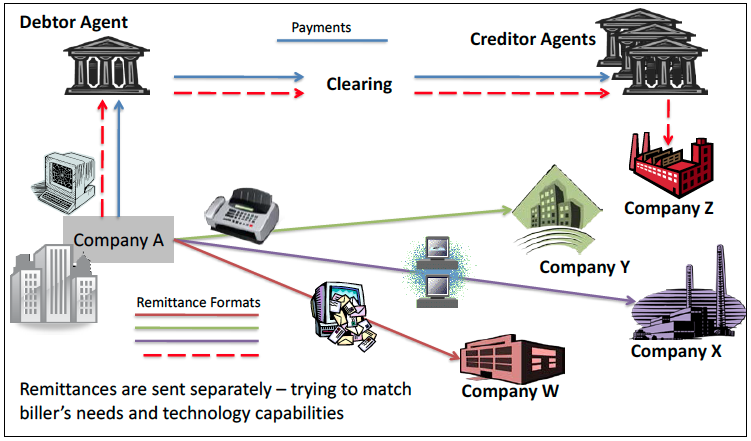
The report reviews the data exchange pathways between creditors, debtors and their respective agents. It also highlights the challenge that Company A faces trying to match remittance formats and technical capabilities with its creditors – challenges the new messages are meant to address, see figure below:
Source & Copyright©2014 - IFX Forum, Inc.
Common use examples
The report then describes seven common examples of likely usage:
- Remittance Advice is sent directly from debtor to creditor.
- Remittance Location Advice is sent directly from debtor to creditor.
- The Debtor’s Agent separates remittance information from a payment message and sends a message to Creditor Agent.
- The Creditor’s Agent separates remittance information from the payment and delivers Remittance Advice to Creditor.
- Debtor Agent separates Remittance from Payment and sends Remittance Advice to Creditor.
- Payment is Direct Debit; Creditor sends Remittance Advice to Debtor.
- Full bank-operated cash management. The creditor’s bank links the remittance data to the credit transfer and reports the remittance information on an account statement using BankToCustomerStatement (camt.053) or credit notification using BankToCustomerDebitCreditNotification (camt.054).
The report then enthusiastically lists other possibilities. (For a copy go to http://www.ifxforum.org)
CTMfile take: This is an important report and contains great ideas on how to exploit the new remittance standards.
Like this item? Get our Weekly Update newsletter. Subscribe today