

Now more than ever, NPLs are key risk to EU banking sector
by Kylene Casanova
On Friday the European Banking Authority (EBA) published a timely report on the risk and vulnerabilities in the EU banking sector, identifying non-performing loans (NPLs) as a key challenge.
Action on NPLs needed
While banks in the EU have in general strengthened their capital position, some banks still have high levels of NPLs and sustained low profitability. The EBA reports that, overall, the NPL ratio has decreased to 5.4 per cent in the EU in the second half of 2016, down from 6.5 per cent at the end of 2014. However, it notes there are “material differences” in asset quality across countries and that more than one-third of EU countries have NPL ratios above 10 per cent. While asset quality for banks in the EU is improving overall, the EBA sounds a cautious note of warning that the impediments of NPL resolution must be tackled in order to secure further gradual improvements in asset quality. It noted: “Action on NPLs is needed, including supervisory actions, structural reforms and development of secondary markets.”
Italy's NPLs in the spotlight
This issue is again in the spotlight, as Italy voted last night to reject the proposals for constitutional reform put forward by Prime Minister Matteo Renzi's coalition government. Overwhelming support for the No campaign, which won by about 60 per cent, led to Renzi's resignation today. The ensuing political uncertainty could jeopardise what the Financial Times called a “last-gasp rescue” for Monte dei Paschi di Siena (MPS), which needs a a €5bn recapitalisation plan, which was under discussion with a group of investors. The FT writes: “Senior bankers will decide whether to pursue their underwriting commitments or exercise their right to drop the transaction because of adverse market conditions.” If the plan fails, the Italian government may decide to nationalise MPS, the world's oldest operational bank, which has lost 10 per cent of its deposits so far this year amid concerns about its NPLs.
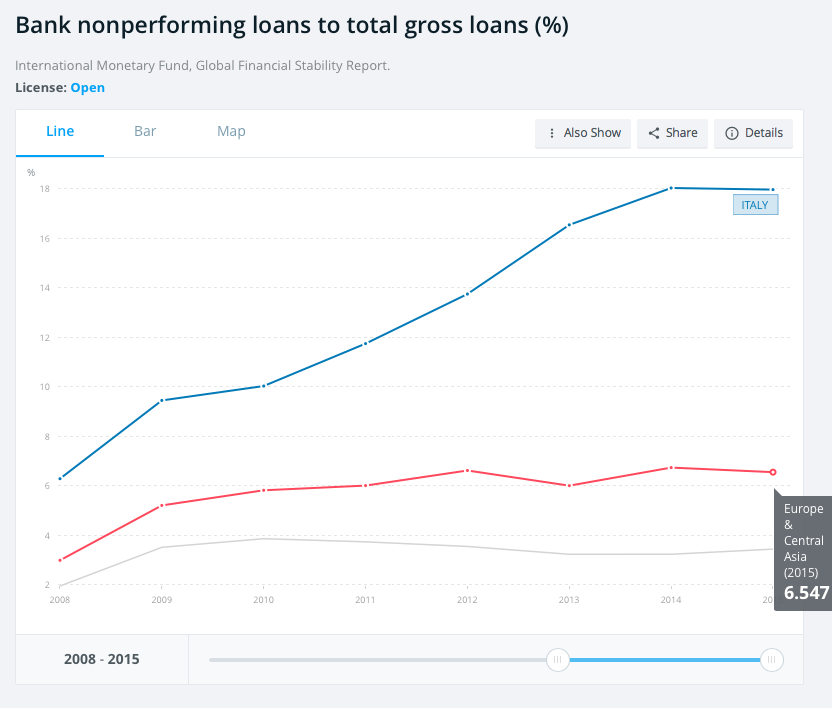
According to World Bank data, the ratio of NPLs in Italian banks compared to total gross loans was at about 18 per cent at the end of 2015, compared to an average of 6.5 per cent in Europe and central Asia (see graph below). Italy's bank NPL ratio stands at three times the pre crisis level of just over 6 per cent in 2008.
Key statements from EBA bank risk assessment
Some of the key statements in the EBA's report – Risk assessment of the European banking system – were:
- Despite the steady strengthening of its capital base, the EU banking sector continues to struggle with high levels of NPLs, low profitability and efforts to restore confidence.
- The first three-quarters of 2016 saw external events creating heightened volatility in market sentiment towards banks’ funding.
- Low (and negative) interest rates have not yet had a negative impact on deposit volumes but deposits have been flat, with growth in previous years stalling.
- The strengthening of European banks solvency, initiated in 2011, has continued.
- More than one third of EU jurisdictions have NPL ratios above 10 per cent.
- Profitability remains a major challenge as EU banks reported an aggregate weighted average return on equity (RoE) of 5.7 % as of June 2016, down by more than 100 bp com- pared to June 2015, albeit an improvement compared to 2015 and 2014 end-of-year data.
- Operational risks appear to be on the rise. Information and communication technology (ICT) risk is increasing whilst litigation and conduct risk-related concerns remain.
- Challenges of NPLs, operational risks and low profitability continue to impact investor confidence in banks and impede the banking sector’s ability to contribute to economic recovery.
Like this item? Get our Weekly Update newsletter. Subscribe today